

Reimagining the United Nations Security Council
Author: Tejasi Bhandari
Published by: Tcharticles | Agastya Market Research
Contact: [email protected]
UN Security Council Reform has long focused on who should occupy its seats. This article instead asks a different question: What should qualify a country to exercise authority over global peace and security?
The current Security Council structure continues to reflect historical power arrangements, raising concerns regarding representation, accountability, and its ability to respond effectively to today’s multidimensional security challenges.
This article proposes a performance-based framework for global security governance, in which Security Council participation is earned through demonstrated responsible behaviour, measurable performance, and sustained contribution to international peace and security. Under the proposed model, all UN Member States would be evaluated through a Peace & Security Performance Index (PSPI), which measures performance across multiple dimensions of security, governance, and development using both progressive performance (improvement relative to a country’s own baseline) and absolute performance (performance relative to other Member States).
The framework also proposes fixed-term allocation of Security Council seats, expanded participation through Core and Observer Members, consensus-based decision-making in place of unilateral veto power, and periodic independent evaluation to determine future seat allocation. By linking authority with responsibility, the framework seeks to strengthen accountability, broaden participation, encourage continuous improvement, and establish performance-based legitimacy as the foundation for global security governance.
Read the Full Article for Free Below.
Uploaded On July, 2026.
Description
UN Security Council Reform:
Reimagining the United Nations Security Council.
‘A Performance-Based Framework for Global Security Governance’
# Core Principle
Authority in global security governance should be earned through demonstrated responsible behaviour and measurable performance, periodically renewed through independent evaluation, and not inherited through historical power.
# Why Does Global Security Governance Need a New Approach?
The United Nations Security Council (UNSC) was established in 1945 with the primary responsibility of maintaining international peace and security. However, its current structure continues to reflect the geopolitical realities of the post–Second World War period, raising questions about its ability to address today’s increasingly complex global security challenges.
Current Challenges in UN Security Council Structure:
| Challenge | Why it Matters |
| Permanent membership | Unequal representation |
| Veto power | Decision-making deadlock |
| No periodic evaluation | Limited accountability |
| Authority derived from historical power arrangements. | Authority remains largely disconnected from current performance |
| No structured pathway to greater participation in global security decision-making | Countries that demonstrate responsible behaviour do not have a structured pathway to achieve greater participation in global security decision-making. |
| Evolving security challenges | Today’s security extends beyond military conflict to include cyber, climate, health, food, economic & many other. |
# Existing Model vs Proposed Model
- While many reform proposals advocate expanding Security Council membership or redistributing seats, most retain a governance model where authority continues to be determined primarily by political power. This model instead seeks to reform the basis on which authority is earned. The proposed model introduces a performance-based approach to global security governance, where participation and authority are determined by demonstrated responsible behaviour, measurable performance, and sustained contribution to international peace and security.
- It replaces a system primarily shaped by historical power with one based on accountability, continuous improvement, and performance-based legitimacy.
- It creates a structured pathway linking responsible state behaviour with greater participation in global security governance, enhances accountability, broadens participation, and aligns global security governance more closely with the principles of the United Nations Charter and the Sustainable Development Goals.
Explanatory Chart:
| Existing Security Council Model | Proposed Performance-Based Model |
| Authority largely based on historical power | Authority based on demonstrated responsible behaviour and measurable performance |
| Permanent membership | Fixed-term membership with periodic evaluation |
| Veto-based decision-making | High-consensus decision-making |
| Limited performance accountability | Continuous performance evaluation |
| Unequal opportunity for participation | Equal opportunity for all UN Member States |
| Static structure | Dynamic and periodically renewable structure |
# How the Framework Works
The proposed model does not assign global security leadership permanently. Instead, it evaluates all UN Member States through the Peace & Security Performance Index (PSPI), ranks their performance, and allocates Security Council seats based on demonstrated responsible behaviour and measurable performance. Periodic independent evaluations ensure that participation remains dynamic and performance-based.

# Evaluation Dimensions
Peace & Security Performance Framework
Countries are evaluated for their responsible behaviour across multiple dimensions of peace & security. Illustrative indicators for each dimension are provided below.
| Dimension | Illustrative Evaluation Indicators |
| Military Security | Participation in disarmament initiatives; peacekeeping and peacebuilding missions; diplomatic conflict resolution; adherence to international humanitarian law; responsible military doctrines (e.g., No First Use); transparency in defence reporting. |
| Human Rights Security | Protection of freedom of expression and peaceful assembly; reduction in custodial deaths and torture; judicial independence; protection of minority rights; accountability for human rights violations |
| Cyber Security | National cyber resilience; prevention of state-sponsored cyberattacks; international cyber cooperation; cybersecurity capacity-building; protection of critical infrastructure |
| Economic Security | Macroeconomic stability; responsible fiscal management; reduction in extreme poverty; employment generation; resilience against economic shocks |
| Food Security | Reduction in hunger and malnutrition; sustainable agricultural policies; food supply resilience; emergency food preparedness |
| Health Security | Universal healthcare access; pandemic preparedness; disease surveillance; vaccination coverage; health system resilience |
| Education Security | Access to quality education; literacy; gender parity in education; investment in human capital |
| Environmental Security | Climate mitigation and adaptation; biodiversity protection; pollution control; sustainable resource management |
| Energy Security | Reliable and affordable energy access; renewable energy transition; energy resilience and sustainability |
| Shelter & Urban Security | Adequate housing; disaster-resilient infrastructure; reduction in homelessness; sustainable urban development |
| Governance & Rule of Law | Democratic institutions; transparency; anti-corruption measures; rule of law; public accountability |
| Institutional Security | Strength of public institutions; administrative effectiveness; crisis management capacity; institutional resilience |
| Humanitarian & Disaster Response | Disaster preparedness; emergency response capacity; humanitarian assistance; international disaster cooperation |
# Evaluation Methodology
To ensure a fair and balanced assessment, each country’s overall performance is evaluated using two equally weighted approaches: Progressive Performance and Absolute Performance. Together, they ensure both continuous improvement and overall excellence. By linking performance with eligibility for Security Council membership, the framework encourages all Member States to continuously strengthen their contribution to maintaining international peace and security.
Explanatory Chart.
| Performance Assessment Approach | Weight | Purpose |
| Progressive Performance | 50% | Measures improvement relative to the country’s own baseline over the evaluation period. |
| Absolute Performance | 50% | Measures a country’s overall performance relative to all other UN Member States. |
| Aspect | Progressive Performance (50%) | Absolute Performance (50%) |
| Measures | Improvement relative to a country’s own baseline | Performance relative to all Member States |
| Purpose | Rewards continuous progress | Rewards overall excellence |
| Key Question | How much has the country improved? | How well does the country perform compared with others? |
| Encourages | Continuous reform | Sustained leadership |
| Benefit | Creates opportunities for improving countries | Recognises consistently high performer |
Why combine both approaches?
Relying only on absolute performance would favour countries that already perform well, while relying only on progressive performance could overlook countries that consistently maintain high standards. By combining both approaches equally, the framework rewards sustained excellence as well as meaningful improvement, creating a fairer pathway to participation in global security governance.
# Performance-Based Allocation of Security Council Seats
- Security Council seats would be allocated through a transparent, performance-based evaluation process rather than permanent entitlement.
- The 15 highest-performing countries, as determined by the Peace & Security Performance Index (PSPI), would be selected as Core Members with full decision-making authority for a fixed 4-year term.
- The 5 countries demonstrating the greatest improvement relative to their own baseline would be selected as Observer Members, recognising their significant progress and providing them with greater participation in mediation, dispute-resolution discussions, and other Security Council deliberative processes.
- During the fifth year (Years 4.5–5.5), Core Members and Observer Members would jointly function as a single integrated group to facilitate a smooth transition before a new performance evaluation determines the composition of the Security Council for the next term.
Explanatory Chart:
| Allocation of Seats | Selection Basis | Role | Term |
| Core Members (15) | Top 15 countries based on the PSPI | Full decision-making authority on Security Council matters | 4 years |
| Observer Members (5) | Top 5 countries showing the greatest improvement from their own baseline | Recognition of exceptional progress; priority participation in mediation, dispute-resolution discussions, facilitation processes, and hosting peace initiatives | 4 years |
| Transition Period | Final year (Years 4.5–5.5) | Core and Observer Members function as a single integrated group to ensure continuity and smooth transition before the next evaluation cycle | 1 year |
# Institutional Framework for Independent Evaluation and Accountability
Who Evaluates Countries, and Who Ensures Evaluator Impartiality?
(Why multiple institutions?)
The credibility of a performance-based Security Council depends on an evaluation system that is independent, transparent, evidence-based, consistent, and accountable. To safeguard fairness and objectivity, the proposed framework separates standard-setting, evaluation, oversight, and dispute resolution into distinct institutional functions.
(Who does what?)
For conducting evaluations, the model proposes a multi-institutional framework rather than assigning complete responsibility to a single authority. This separation prevents concentration of power and ensures that different institutions are responsible for methodology development, evaluation, oversight, and dispute resolution.
Explanatory Chart:
| Proposed Institutional Bodies | Primary Responsibility |
| UN Peace & Security Standards Commission (PSSC) | Develops and periodically reviews the Peace & Security Performance Index (PSPI), including indicators, scoring methodology, and technical standards. |
| UN Peace & Security Evaluation Commission (PSEC) | Conducts country evaluations using the approved PSPI methodology. |
| Independent Oversight Panel | Reviews procedural compliance, transparency, and ethical standards without influencing evaluation scores. |
| Independent Review Panel | Reviews appeal related to procedural errors, evidence assessment, or incorrect application of methodology and may recommend re-evaluation where justified. |
(Who actually assesses?)
Composition of the Evaluation Team
Each evaluation would involve specialised teams working independently within their respective areas of expertise, with their findings consolidated through a common evaluation framework. Representatives of the evaluated country should not participate in assigning or approving their own score. However, they should have the right to review draft findings, submit additional evidence, and seek clarification before the evaluation is finalised.
Explanatory Table:
| Members | Role |
| Independent Evaluation Officers | Lead the overall assessment and scoring process. |
| Subject-Matter Experts | Assess specialised dimensions such as military security, human rights, cyber security, health, environment, governance, and economic security. |
| Data & Statistical Analysts | Verify datasets, calculations, scoring consistency, and statistical accuracy. |
| Legal & Ethics Experts | Ensure compliance with international law, procedural fairness, and ethical standards. |
(Based on what information?)
Evidence Framework
All evaluations should rely on independently verifiable, internationally recognised, and publicly accessible evidence wherever possible. National data may also be considered where it has been independently audited or internationally validated. Refer explanatory chart below:
| Evaluation Area | Illustrative Evidence Sources |
| Human Rights | OHCHR, UN Treaty Bodies, Special Rapporteurs, independently verified national data |
| Peacekeeping & Security | UN Department of Peace Operations (DPO), UN Security Council reports |
| Health Security | WHO |
| Food Security | FAO, WFP |
| Education | UNESCO |
| Economic Security | World Bank, IMF, internationally recognised economic datasets. |
| Environment & Climate | UNEP, UNFCCC |
| Governance & Development | UNDP, internationally recognised governance datasets |
(Who checks fairness?)
Oversight Mechanism
To strengthen transparency and confidence in the evaluation process, an Independent Oversight Panel should monitor procedural integrity without participating in scoring decisions.
The Panel may include:
| Oversight Members | Purpose |
| Representatives nominated by the UN General Assembly | Ensures institutional accountability. |
| Representatives from the evaluated country | Observes the process, provides factual clarifications, and safeguards procedural fairness without influencing the evaluation outcome. |
| Representatives from a randomly selected UN Member State | Enhances impartiality and peer confidence in the evaluation process. |
How does the evaluation process ensure fairness and accuracy?
Procedural Safeguards in the Evaluation Process
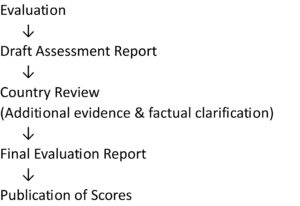
To ensure fairness, accuracy, and consistency, every country evaluation would follow a transparent review procedure. Countries would be given an opportunity to examine draft findings, submit additional evidence, and request factual corrections before the final evaluation results are published.
(How are disagreements handled?)
Dispute Resolution Mechanism
To maintain confidence in the evaluation system, countries may challenge evaluations only on procedural grounds, factual inaccuracies, or the incorrect application of the approved methodology. An independent review process ensures that disputes are resolved objectively while preserving the integrity and consistency of the evaluation framework.
Explanatory Chart:
| Stage | Process |
| Initial Review | The evaluated country may challenge factual errors, procedural irregularities, or overlooked evidence. |
| Independent Review | The Independent Review Panel examines whether the approved methodology and procedures were correctly applied. |
| Outcome | If significant procedural deficiencies are identified, a partial or full re-evaluation may be ordered. Otherwise, the published evaluation remains final. |
# Evaluation Outputs
Each evaluation generates 3 outputs namely, overall PSPI score, dimension wise score, evaluation report. Through these outputs, countries would not only know where they rank, but also why, and what they need to improve before the next evaluation cycle. It would align with objective of encouraging continuous responsible behaviour rather than simply ranking states.
Explanatory Chart:
| Output | Purpose |
| Overall PSPI Score | Determines Security Council eligibility. |
| Dimension-wise Scorecard | Shows performance in Military Security, Human Rights, Cyber Security, etc. |
| Evaluation Report | Explains strengths, weaknesses, evidence considered, and recommendations for improvement. |
# Decision-Making Mechanism for Security Council
- Under the proposed model, the 15 countries with the highest overall Peace & Security Performance Index (PSPI) scores would form the Core Group responsible for Security Council decision-making.
- Unlike the existing veto-based system, decisions would require a 90% majority among Core Members, encouraging negotiation, reducing the possibility of unilateral blocking by individual states, promoting collective responsibility, and strengthening the legitimacy of Security Council decisions.
- Observer Members would not possess voting rights in formal decision-making. However, recognising their demonstrated improvement and contribution to peace and security, they would participate in consultations, mediation efforts, dispute-resolution processes, peacebuilding initiatives, and other Security Council-related activities.
- Demonstrated performances of observers in such engagements, including successful mediation, conflict-resolution support, and peacebuilding contributions, would be considered as part of future PSPI evaluations, subject to the same evidence-based assessment framework applied to all countries.
Explanatory Chart:
| Category | Role in Decision-Making and Evaluation |
| Core Members (15) | Hold full decision-making authority. Decisions require a 90% majority among Core Members. |
| Observer Members (5) | Participate in consultations, mediation, dispute-resolution discussions, and peacebuilding initiatives without voting rights. Their measurable contributions through these engagements be considered in future PSPI evaluations. |
# How This Model Encourages Responsible State Behaviour
The greatest impact of this framework is not only who gets a seat—it is how countries behave to earn one.
Under this framework, Security Council participation would be linked to demonstrated responsible behaviour and measurable performance. Countries would need to achieve and sustain improvements across key peace, security, governance, and development indicators to earn and retain a role in global security decision-making.
| Area | Expected Behavioural Change |
| Human Rights | Strengthened protection of rights and reduce violations |
| Peace & Security | Investment in conflict prevention, peacebuilding, and responsible security practices |
| Governance | Improved transparency, accountability, and institutional effectiveness |
| Diplomacy | Dispute resolution through dialogue and peaceful mechanisms |
| Development | Accelerated progress towards sustainable development goals |
| International Cooperation | Increased contributions to addressing global challenges |
Thus, the framework transforms Security Council membership from a privilege based on historical position into a responsibility earned through continuous contribution, accountability, and measurable performance.
# Concluding Remarks
- The central challenge of Security Council reform is not only who should occupy its seats, but what should qualify a country to exercise authority over global peace and security.
- A performance-based model does not eliminate geopolitical realities. Instead, it introduces a stronger principle for allocating authority.
- Authority in global security governance should not be inherited through historical power; it should be earned through demonstrated responsible behaviour, measurable contribution, and continuous accountability.
- By linking authority with responsibility, this framework seeks to transform global security governance from a system based primarily on historical power distribution into one based on performance, legitimacy, and shared responsibility—where participation in Security Council decision-making is earned through demonstrated contribution rather than inherited through historical position.
————————————————————————-END———————————————————————————–
UN Security Council Reform is an important conversation. Share your perspective in the comments section.

Reviews
There are no reviews yet.